Cohere has become completely irrelevant in the frontier LLM race. This has been clear for more than a year if you follow that race. Yet, here's Mark Carney boosting them just last month:
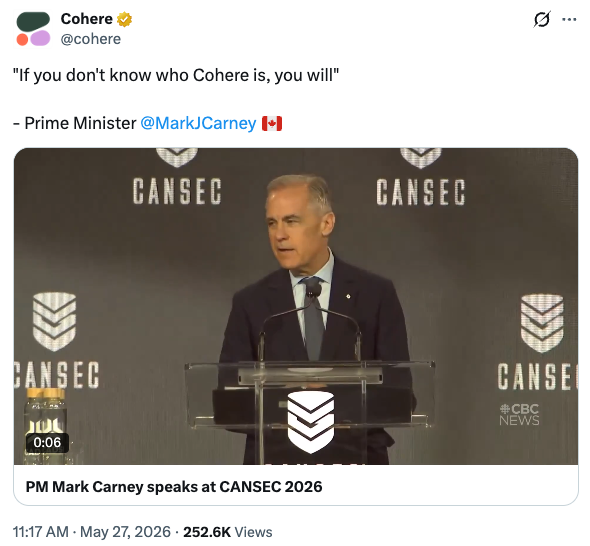
He was probably misled by his AI Minister Evan Solomon who also thinks highly of Cohere:
Evan Solomon thinks Cohere is world-class.
Unfortunately, the competition is brutal and reality does not support this boosterism. You can easily tell that Minister Solomon is grasping at straws since the second company he mentions is publicly traded:
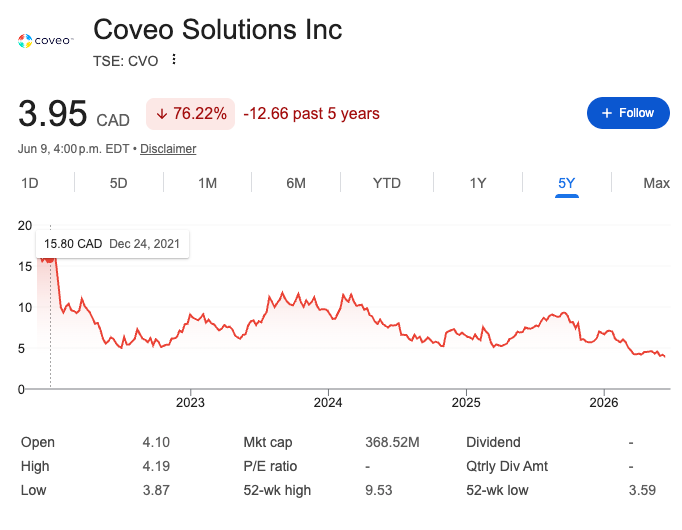
Does this look like the stock of a company at the leading edge of AI? The Cohere story is harder to discern, but I am pretty confident in saying that Cohere has nothing that is both proprietary and valuable. They do have a high concentration of talented AI people, so they are closer to a service company than a software company.
First, the very basics: Cohere is, to this day, primarily about making AI models, chiefly Large Language Models (LLMs). LLMs power AI chatbots like ChatGPT, among other applications. To simplify, LLMs can be objectively evaluated along 2 main measures: intelligence vs cost. This is a simplification since there's no universal measure of intelligence - one LLM can be better at coding but weaker at writing. Nevertheless, there are general benchmarks. As you would expect, there's also a tradeoff curve. Anthropic, for example, reliably makes the most intelligent models, ie the Claude series, but they are also the most expensive. In contrast, a handful of Chinese models are not quite as smart as Claude, but they can be 10-20x cheaper. If a model is not somewhere in the vicinity of this "efficient frontier", it's irrelevant, no one is going to use it. It has been a long time since Cohere has made anything that registers on this efficient frontier. Here's how benchmarking company Artificial Analysis evaluates Cohere's current flagship LLM.
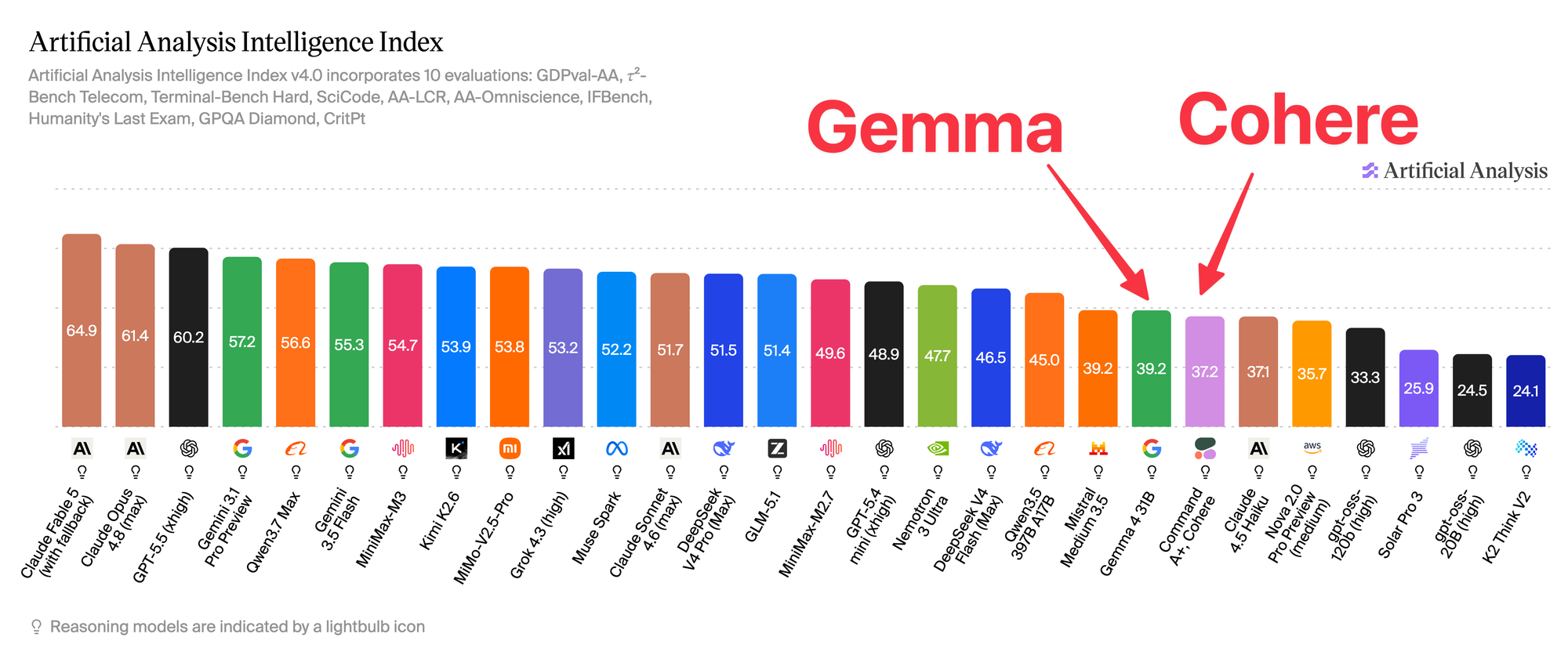
So, on an absolute basis, Cohere is outclassed by a whole bunch of models. Cohere's model is slightly less smart than a model called Gemma 4 31B - made by Google. That's a highly inconvenient fact. Because Gemma is free for anyone to use. You can just download it and use it entirely on your own hardware, ie it's "open source." Cohere's model is also open source - but it will cost you 2x-4x as much as Gemma in hardware or cloud costs, due to its size and architecture. It is therefore not on the efficient frontier.
Of course, Cohere has revenues, so some people do pay to use their models. There are a few reasons for this. First, it's possible to fine-tune models for specific tasks, essentially continuing their training by giving them additional information. And so you might not care if the model is generally weaker, if it has been post-trained for your specific business tasks. But this still raises the question: why would your starting point be a Cohere model, when Gemma is available?
The other angle Cohere can use to finagle enterprise clients is the concept of SOVEREIGN AI. This includes the notion of not sending your company's data to a third-party AI lab like OpenAI or Anthropic. This is especially valuable to highly regulated fields like financial services and healthcare. And also defence and the public sector. Cohere is now primarily reliant on selling sub-par AI tools using this SOVEREIGN angle.
One aspect of this is spreading sinophobia. While Gemma is OK, several smaller Chinese LLM makers deliver even more impressive intelligence/cost value. And they release their models as open source, meaning they are much cheaper, often free (except for the compute costs). You can use your own hardware so your data stays secure in Canada. If an enterprise could get Chinese models customized by Cohere, that would be the dream. But of course, that would make Cohere a mere service provider, without proprietary tech. The use of Chinese models is now widespread and growing as the entire field has become more cost-conscious, and as subsidized AI usage is going away.
You can see the popularity of the Chinese models by going to the website of a major cloud provider like Microsoft Azure. Among their "featured models", they list Kimi and DeepSeek, both Chinese. They even feature French national AI champion Mistral. But you'll have to dig deeper to find Cohere.
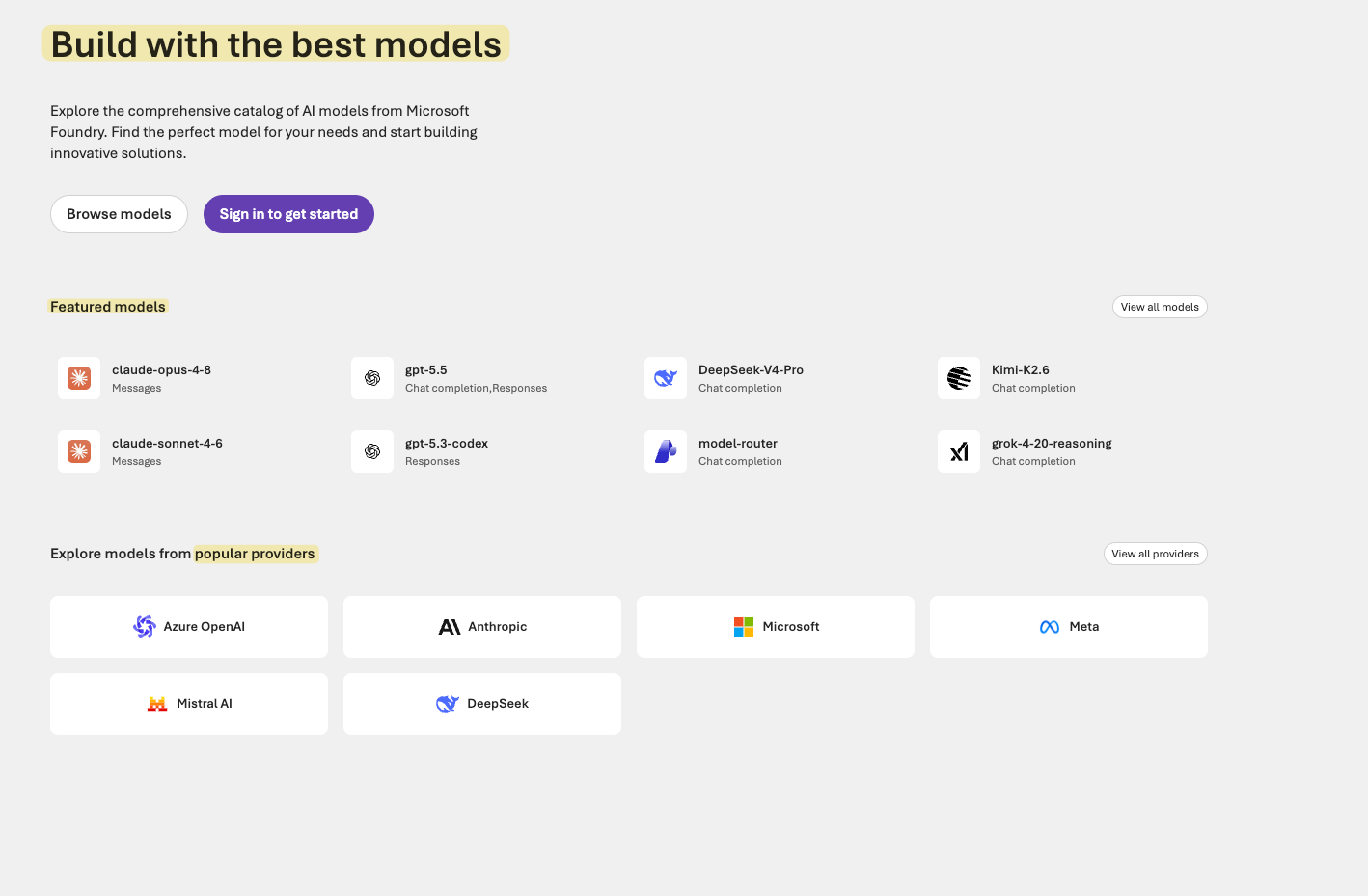
This list by itself is longer than it needs to be: Mistral is a laggard and Meta's LLM efforts have to date faltered. Meta is a good example of how brutal the competition is: they spent many billions on their LLM efforts and recently doubled down. To date, they have very little to show for it. Cohere is in a similar situation: very smart people who made a prescient bet: LLMs for enterprise use cases. But they were overtaken by the competition.
No hype from experts
One of the reasons Lululemon stumbled is because it didn't adapt to influencer-led marketing. There are of course a lot of AI influencers. I have not seen a credible AI influencer hype any Cohere tooling in about 18 months. Err...except for this e-commerce entrepreneur:
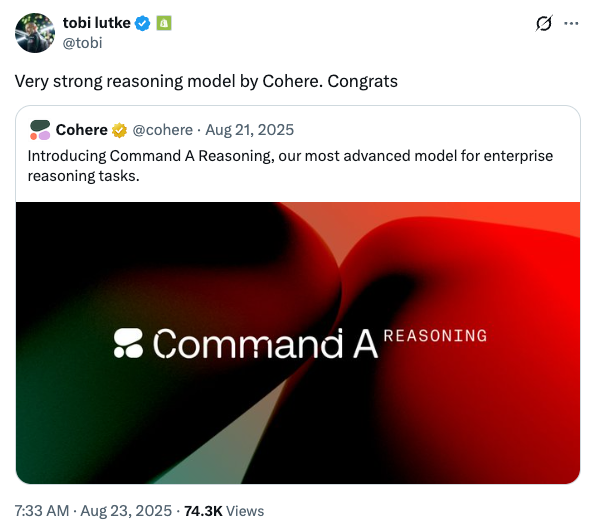
But that doesn't count, that was just a pity tweet. I guarantee that no one at Shopify is using Cohere models to any meaningful degree. You have to wonder why the most tech-forward companies in Canada, like Shopify or Wealthsimple are not using Cohere. Tech companies love to feature the logos of their most impressive clients on their homepage. Cohere has to trot out Bell Canada and other resellers whose tech stamp of approval is not worth a whole lot.
People making policy prescriptions should have a high regard for the truth. Here's Tobi's Build Canada toeing the party line and calling Cohere's latest LLM "frontier" - a laughable assertion, given what I have shown above.

It's only a minority who are willing to speak up. I found this tweet by a PhD candidate in AI useful:

Daniel made perfectly valid points. Cohere co-founder and Chief Lobbyist Aidan Gomez engaged him, but the discussion devolved into pop psychology:

No market share
Intelligence is a vague concept. But user preference expressed through the billions that are spent on AI inference reveals what people value. Millions of users are voting with their dollars on which models give them the best deal on intelligence. Cohere is nowhere to be found on such leaderboards.

Given the talent pool in Canada and what happened over the thirty years of the dotcom revolution, it's reasonable to surmise that someone somewhere in Canada is building the Next Big Thing, the AI version of Shopify. There's zero reason to think that the government can identify this with anything approaching prescience. And as a matter of smart IT spending, favouring a vendor that starts with lower-quality LLMs is a disservice to the public.
.