The entire fintwit cognoscenti is abuzz with the outcome of a very interesting experiment in the markets. A private real estate fund recently converted into a public fund and started trading on the NYSE this week. Bluerock Private Real Estate Fund, with assets of US$4.3B, promptly experienced a 40% drop from its last published NAV (from when it was a private fund). From a "private" NAV of $24.36, it's around $15 today. More than 10 million units have traded. One reasonable explanation for such a precipitous fall is that there were a lot of motivated sellers who had been waiting for liquidity. Nevertheless, the judgement of thousands of knowledgeable investors declining to buy at anything close to the "private" NAV is worth taking note of. Here's a related tweet by Boaz Weinstein, who is in the business of buying publicly traded funds at a discount.
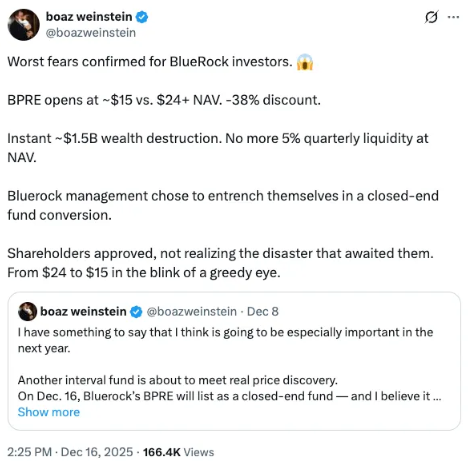
The reason Bluerock decided to list the fund on an exchange is because they faced redemption pressures. But they did not want to be a "forced seller" of their assets. Nicola uses similar arguments for gating its funds and there's a useful lesson for their clients. If at all you can, take advantage of the artificial high prices of their real estate funds. Being a client in a Ponzi scheme is not necessarily a bad idea - if you are alert enough to leave early and stash your money somewhere recovery-proof. Nicola is not a Ponzi scheme, not in the classical sense. But its clients had a golden opportunity to take their illusory gains and run. The big clue was in 2022, when the Nicola story about magical returns without volatility jumped the shark. In a year when both stocks and bonds fell, Nicola reported a gain. Nicola claimed its real estate portfolio was up about 20 per cent versus a REIT market that was down by about 25 per cent.
The Globe covered this magical story thusly:

This was a typical credulous Globe story, but without even being prompted, John Nicola addressed the inconsistency of Nicola’s returns:
Some commentators have said to me, ‘Well John, you’re dealing in private markets, and the public markets are marked-to-market.’ But I tell them the opposite is true. REITs are trading at 25 per cent below their net asset value, which means they are not the market. They are the public’s reaction to external events. They’ve been oversold. The actual market – what buildings are being bought and sold for – that’s the real market.
There is a grain of truth to this, public investors are prone to panicking in a way that an intelligent owner of a private business or building rarely does. But John’s explanation overlooks something that is as close to a law of nature in finance: rising interest rates lower the value of income-generating assets. That year, the 10-year U.S. Treasury yield jumped from 1.8% to 3.5%. A 1% rise in cap rates typically wipes out about 20% of a building’s value if rents don’t move. So it takes magical thinking to claim a diversified North American real estate portfolio could have gained 20% that year. Nicola is primarily an investor in multi-family real estate generally in urban North America, with some concentrations in BC, Ontario and the US Sunbelt. Nicola was most active as a buyer in the peak years of 2021 and 2022.
To this day, on its two big real estate funds (US and Canadian), Nicola only shows flat-lining performance. It refuses to take meaningful losses. Yet, those funds’ distributions (reflecting operating income) have been reduced by 37% and 46% respectively. Just think what would happen in the stock market if a REIT or any dividend paying stock suddenly cut distributions by 40%. The REIT or stock would either crater on the news or would have in anticipation of the news. Neither the clients nor the media are asking these basic questions. Not surprisingly, Nicola doesn’t want to talk to me.
The generic term for Nicola’s scheme is volatility laundering. Just like Ponzi schemers lure clients with fake growth, volatility laundering consists in creating the illusion of low volatility. Nicola actually claims both better returns and lower volatility over a period 25 years. This is simply too good to be true. This happens because Nicola has a great degree of influence on how its private assets are valued ("marked"). Just as in a Ponzi scheme, as long as clients don’t ask their money back, the illusion can be maintained. But the troubles start when clients want their money back.
I said before that any sincere professional would understand what Nicola was up to. The only question is who would be willing to speak up about it. Leith Wheeler’s VP of marketing, Mike Wallberg, wrote an opinion piece in the Globe in May 2024 titled “Understanding the illiquidity trap.” It warned about individual investors having alarming levels of private assets. This is a thinly veiled attack on its cross-town rival Nicola. He makes a very good point about how having a large allocation to privates crimps your ability to rebalance. For instance, when Nicola real estate was “up” 20% in 2022, wouldn’t that have been a great opportunity to trim that part in favour of everything else that had fallen? Of course, Nicola is too conflicted to sell their own proprietary products in favour of cheaper assets (including the REITs that were supposedly selling at a 25% discount to NAV).
Nicola’s real estate exposures
Nicola’s disclosures are weak, even to their clients. Unlike some other private real estate funds, they do not disclose nearly enough data so that investors can check their valuations. But Nicola does provide a full listing of the properties it owns at this link.
Here’s a sample transaction. Nicola US Real Estate owns a 25% interest in Avasa Grove West in a suburb of Tampa, Florida. Nicola’s close partner Venterra Realty is the manager. The property was acquired in 2023 for $95m from D.R. Horton. That’s a $50B publicly traded homebuilder in which Berkshire Hathaway owns a small stake. Venterra bought the building on the assumption that they are good operators of rental properties. (This might well be true, the “built-to-rent” trend is fairly recent, the rental experience in such projects has seen some improvement in the past 10 years.) But when I go on their website, they advertise 2 months rent free. That’s generally at the upper end of a landlord’s desperation to rent. Nicola cites such “tenant inducements” as one of the factors why they had to reduce cash payouts.

There is nothing magical about any of this. If Venterra is a sharp operator, then over decades it can realize a satisfactory return. But it’s not immune from cycles. Nicola will say that they have to delay redemptions to avoid “selling buildings at a discount.” At a discount to what? The ultimate test of value is what informed buyers are willing to pay for an asset. Clients should randomly pick a few properties and force Nicola to put them on the market to prove that their NAV is realizable. One hurdle to selling properties and giving clients money back is that Nicola is often just a minority part-owner. For example, the Tampa project, it only owns a 25% interest. Clients should keep in mind that no matter what great real estate bargains Nicola was able to acquire (a doubtful proposition), what matters to any individual client, is at what valuation (Net Asset Value) they buy into the fund. There’s good reason to believe that clients who bought in the past 3 years overpaid for their fund units.
Aspects of a Ponzi scheme
Firms like Nicola and Ninepoint are primarily marketing machines. Virtually every money manager - even Vanguard - wants to manage more money. But private market operators have a special incentive to ramp up their marketing, which they certainly do, in my observation. Raising a lot of fresh money is a way of washing away your past sins. Here’s a simplified example. Let’s say I raise a real estate fund with $1m in assets on Day 1. By the end of the year, I claim I have tripled investors’ money. This attracts so much interest that by year 2, I have $100m in new client money. You can see that the fresh money offers me the ability to dilute any mistakes I made in Year 1. If I overstated assets by $2m in Year 1, that is merely a loss of around 2% in Year 2. I am not necessarily claiming that this happened at Nicola in a malicious way. But the entire arrangement, including performance fees, is highly favorable to Nicola and detrimental to the client’s interest.
The fee issue
Even leaving aside valuations, Nicola is problematic on multiple levels. To some extent, the inability to meet redemption requests is not the biggest issue. In the long-term, the bigger issue will prove to be lousy performance and excessive fees. They have no special investment acumen and they charge very rich fees. That is all you need to understand to avoid them.
Charging excessive fees runs in the family. Nicola’s incoming CEO Chris Nicola co-founded robo-advisor WealthBar, which was eventually sold to CI Financial and re-branded as CI Direct Investing. WealthBar offered funds managed by Nicola that had MERs as high as 2.93%. This is unconscionable in the ETF era.
The propaganda
Building a large money management firm on shaky foundations like Nicola requires a network of enablers who will further the illusions they’re peddling. Nicola has posted the recent Globe and Mail article about their liquidity troubles on its client portal. It’s a mutually beneficial partnership!

In the latest Globe article, John Nicola is quoted as saying “Quite frankly, we’ve never seen this before” referring to the “contagion” of fear in relation to private funds. The exact same thing happened in 2021 when Bridging Finance collapsed, a number of other private debt funds had to impose redemption freezes. Contagion is a basic aspect of markets. If you lived through 2008, you saw fear so pervasive that even money-market funds felt unsafe.
Nicola is lowering distributions to match the diminishing cash flows from their real estate but pairing that with a Systematic Withdwrawal Plan (SWPs) to cushion the blow for income dependent investors. To investors who do not look closely, it may seem like their cash flow has not changed, but in reality, the partnership is paying less income and the difference is being carved out of their own capital through NAV based redemptions.
I have seen communications where people with 6 figure portfolios are asking for their money back and being turned down. This is a breach of the basic moral contract between a wealth manager and retail clients and it was entirely foreseeable. Some Nicola clients depended on the income from the real estate pools for their living expenses.
I will give John Nicola credit for recognizing that an individual investor benefits from being exposed to multi-family assets in great cities. It’s a safe bet that people will still be competing to live in central Toronto 20 years from now. But the implementation of this insight by Nicola has not been remotely client-friendly and Nicola clients will progressively wake up to it.
You can use my search function to find my previous articles on Nicola Wealth. This was my last post on Nicola Wealth:
 OPM
OPM